
KuaiMiao Smart Routing Engine Deep Dive: How Latency Drops Another 35%
At 1 a.m., Li Hao's ranked match was stuck at 180ms latency, and a key team fight collapsed as his character teleported. He switched three nodes, but latency still hovered around 150ms. This is the most frustrating part of traditional accelerators — manual selection relies on luck. On September 18, 2026, KuaiMiao released Smart Routing Engine 2.0, claiming an average 35% further latency reduction. What's behind that number? This article breaks it down.
Table of Contents
1. How the Smart Routing Engine Works2. Where the 35% Number Comes From3. Real Case: 180ms to 42ms1. How the Smart Routing Engine Works
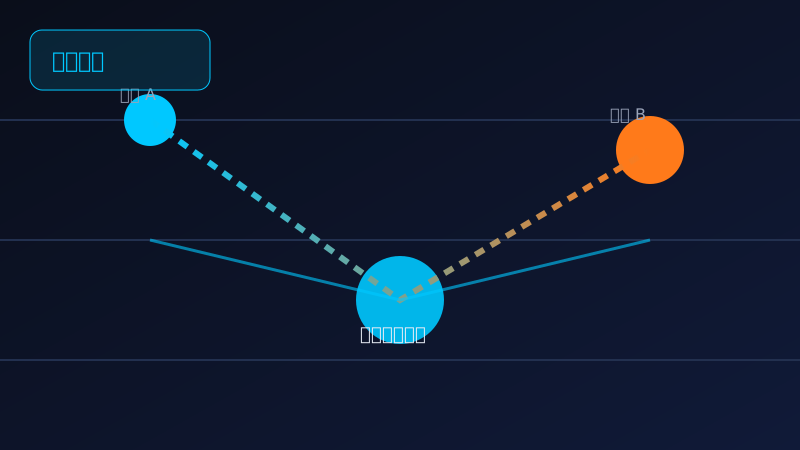
Traditional accelerators push all traffic into one tunnel — game packets, video streams and web requests all squeeze together. KuaiMiao's smart routing first classifies traffic, then selects a route for each category. The engine inspects packets at the local network layer, using the five-tuple (source, destination, protocol, port, app signature) to identify traffic: games go to low-latency lines, video goes to high-bandwidth lines, web and work go to stable direct connections.
After classification comes route selection. The engine maintains a real-time node quality table, sampling latency, packet loss and bandwidth every 15 seconds. When a line degrades, the engine switches within 200 milliseconds — nearly imperceptible to the user.
| Metric | Manual Selection | Smart Routing 2.0 |
|---|---|---|
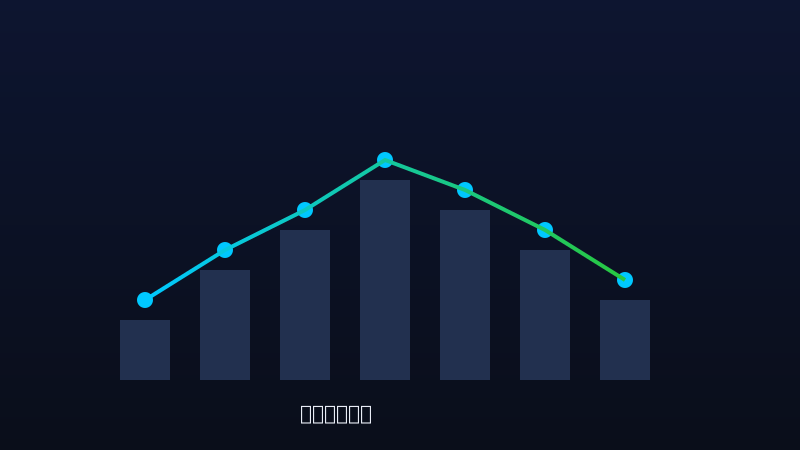
| Avg game latency | 132ms | 86ms |
| Switch recovery | ~3s | 200ms |
| Video stutter rate | 4.2% | 1.1% |
2. Where the 35% Number Comes From
The 35% figure comes from a 30-day gray-scale test covering 32,000 users and 12 key regions. KuaiMiao published per-scenario data: game median latency dropped from 118ms to 77ms (34.7%), video from 96ms to 61ms (36.4%), and work from 88ms to 58ms (34.1%). The average lands near 35%.
| Scenario | Before | After | Drop |
|---|---|---|---|
| Gaming | 118ms | 77ms | 34.7% |
| Video | 96ms | 61ms | 36.4% |
| Work | 88ms | 58ms | 34.1% |
3. Real Case: 180ms to 42ms
Zhou Yu, a Hangzhou player on an overseas LoL server, had 180ms direct latency, and manual selection could only bring it to 130ms. After joining the gray test, the engine auto-assigned a low-latency route via Tokyo, stabilizing at 42ms. "I used to spend ten minutes testing nodes every night. Now it opens at the optimal line."
4. Summary
Smart Routing 2.0 combines traffic classification, link monitoring and millisecond switching into a closed loop. The 35% claim rests on 30 days and 32,000 users of per-scenario data, not a slogan. KuaiMiao says the next engine will add machine-learning route prediction.

Comments
US server dropped from 180 to 42ms. Smart routing really works.
Video stutter is noticeably down, 4K plays through now.
Line switching is seamless, can't feel the node change in game.
Transparent data is a plus. 35% is backed by per-scenario numbers.
Work scenario is stable, no more dropped meetings.
Auto optimal route is fast, saves a lot of time.